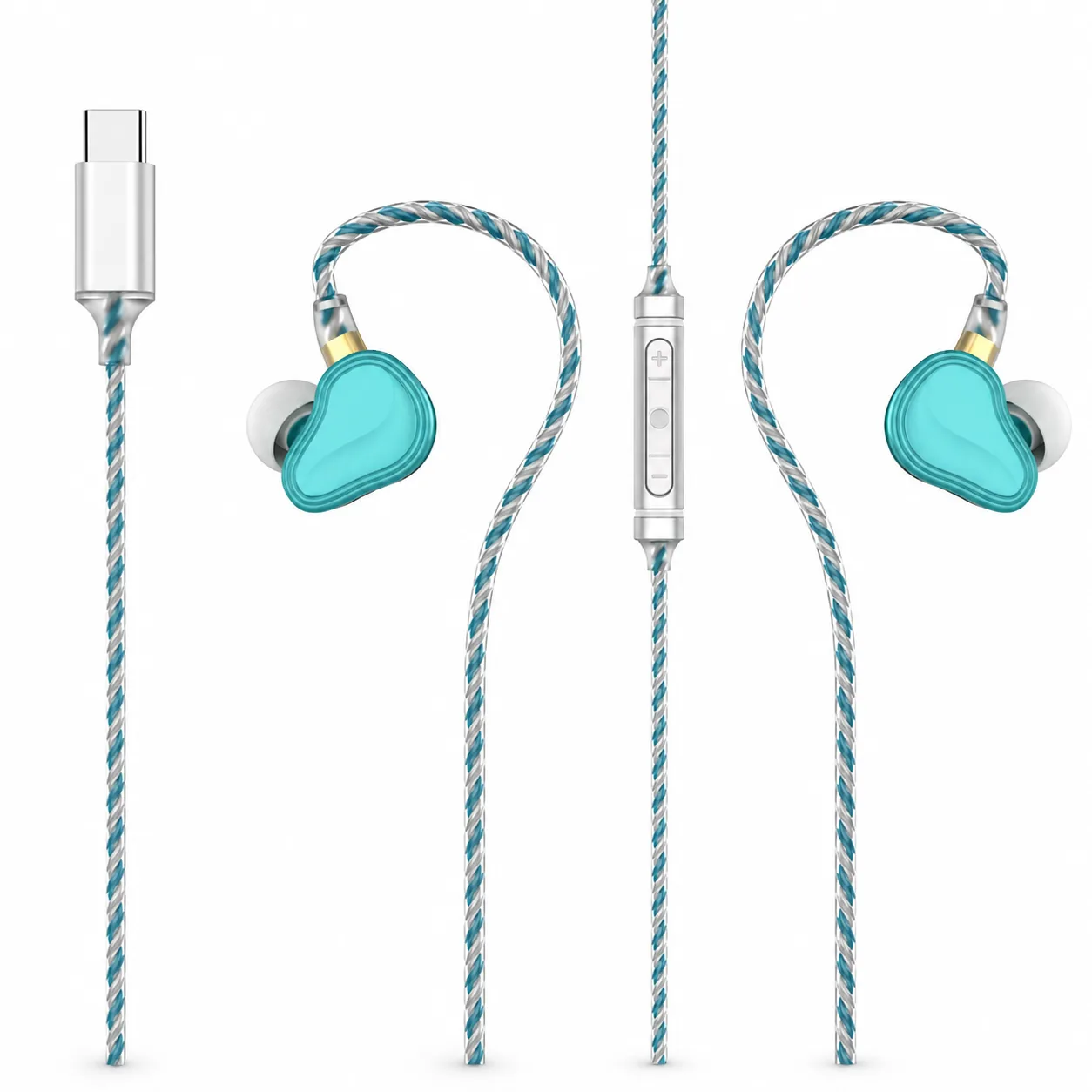
The driver configuration influences tuning flexibility, housing design, cost and quality control, but driver count alone does not determine sound quality. A well-developed single dynamic-driver IEM can outperform a poorly integrated hybrid. Buyers should start with their customer, acoustic target and price position, then select the platform that can be produced consistently.
Single dynamic-driver IEMs
A dynamic driver uses a diaphragm, voice coil and magnet to reproduce the full frequency range. It is widely used because it can deliver coherent sound, convincing bass and a straightforward acoustic structure.
Typical advantages
- Natural coherence because one driver covers the full range.
- Strong low-frequency capability when the diaphragm, chamber and venting are well matched.
- Fewer crossover and integration variables.
- Competitive BOM and easier positioning for volume programs.
Points to evaluate
Driver diameter alone is not a quality guarantee. Ask about diaphragm material, impedance, sensitivity, chamber volume, venting, nozzle filter and production tolerance. The same driver may sound different in another shell or with another ear tip.
Hybrid DD+BA IEMs
A hybrid platform combines a dynamic driver with one or more balanced-armature drivers. The dynamic driver commonly supports bass and lower mids, while the BA unit can extend or shape the upper-mid and treble region.
Typical advantages
- More tuning options across different frequency regions.
- Potential for added detail or upper-frequency extension.
- Clear technical differentiation for a premium product story.
Points to evaluate
Integration is critical. Driver placement, acoustic tubes, crossover components, damping and phase behavior must work together. More drivers increase BOM cost and assembly complexity and do not automatically improve the listening result.
Side-by-side sourcing comparison
| Decision area | Single dynamic | Hybrid DD+BA |
|---|---|---|
| Sound direction | Coherent, often strong bass and natural full-range presentation. | Greater multi-band tuning flexibility when integrated correctly. |
| Development | Simpler acoustic architecture and faster starting point. | Requires careful crossover, damping and phase evaluation. |
| BOM position | Usually more cost-efficient for volume programs. | Higher component and assembly cost. |
| Marketing | Easy to explain through diaphragm, tuning and comfort. | Useful premium story, but claims must match real performance. |
| QC focus | Driver matching, seal, vent and frequency-response consistency. | All single-DD checks plus driver integration and crossover consistency. |
Choose by customer use case, not driver count
For mainstream music listening, gaming audio or distributor programs with firm target pricing, a well-tuned dynamic platform may be the best choice. For monitoring-oriented or premium HiFi positioning, a hybrid can offer additional acoustic options if the development budget and schedule allow proper tuning.
Define the tuning target before sampling
Send reference products or a written target describing bass level, vocal position, upper-mid presence and treble character. If possible, provide a target frequency-response curve. Confirm how the supplier measures left/right matching and production tolerance. Listening tests and measurements should use the final ear tips, filter and cable.
Cables, connectors and digital options
The cable affects usability, appearance and positioning. Define conductor direction, core count, jacket, braid, microphone, inline controls, length and connector. Detachable 0.78mm 2-pin or other connector directions can support aftermarket replacement. For USB-C digital products, define the DAC/DSP chipset, supported sample rate, microphone path and device compatibility. A claim such as 24-bit/96kHz must be verified across the complete digital signal path.
Housing, process and acoustic filters
ABS, PC, metal covers, plating, painting and printed logos create different cost and cosmetic risks. The nozzle mesh or acoustic filter affects tuning and protection. For sports or premium serviceability projects, buyers can discuss hydrophobic or replaceable filters and a suitable water-resistance target, but the final claim needs project-specific validation.
What to request in the sample report
- Model and driver configuration.
- Impedance, sensitivity and frequency range.
- Frequency-response curve and left/right matching.
- Distortion or other agreed electro-acoustic measurements.
- Housing material and surface process.
- Cable construction, connector and microphone/control functions.
- Accessories, ear tips, packaging and compliance scope.
Recommended OEM sampling sequence
- Shortlist two or three housing and driver platforms.
- Confirm the commercial range and target market.
- Build acoustic samples with the intended cable, filter and ear tips.
- Review measurements and listening feedback.
- Freeze tuning before logo, packaging and pre-production approval.
Frequently asked questions
Is a hybrid IEM always more expensive?
It usually has a higher BOM and assembly cost, but the final price also depends on the shell, cable, controls, accessories, finish, packaging and order quantity.
Can the same housing use different drivers?
Sometimes, but a driver change normally requires renewed acoustic evaluation because chamber volume, vents, filters and damping interact with the driver.
What should a buyer include in an IEM RFQ?
Include the market, target retail position, quantity, preferred driver direction, connector, cable, microphone, sound target, finish, logo, accessories, packaging and compliance needs.